


Define success before the demonstration
A workflow that runs is not automatically a workflow that helps. It may move a task faster while creating extra review work, duplicate records, or confusing messages. A pilot should answer a business question: does this change improve a specific process under real operating conditions?
Write that question before implementation. For example: can the team handle incoming inquiries more consistently without increasing corrections or missed follow-ups? Choose a narrow process so that the result can be understood and the changes can be reversed if necessary.
Record a useful baseline
Observe the current process over a representative period. Record how many items arrive, how long they take, where they stall, and how often someone corrects a mistake. Use consistent definitions, including when the clock starts and what counts as completion.
Separate different types of work. A straightforward appointment request should not be compared directly with a complex service inquiry. Note changes in staffing, promotions, opening hours, and demand. Those factors can affect the outcome even when the workflow itself has not changed.
Choose a small balanced scorecard
Track speed alongside quality and effort. The following measures are suggestions for a pilot, not LEGWRK performance claims. Select the ones that fit your process and can be measured reliably.
- Volume: items received and items eligible for the pilot.
- Speed: time to a meaningful response and time to completion.
- Quality: incorrect records, duplicate actions, and required corrections.
- Reliability: failed runs, unresolved exceptions, and recovery time.
- Human effort: handling time, review time, and exception work.
- Customer outcome: completed appointments or another clearly defined next step.
Count the work automation creates
Include setup, training, monitoring, and review effort. If AI drafts a response in seconds but a person spends several minutes correcting it, those minutes belong in the evaluation. Record software and usage costs separately from labor estimates so assumptions stay visible.
An illustrative calculation: if a task previously took six minutes and now takes four minutes including review, the observed difference is two minutes per comparable task. At one hundred tasks, that is two hundred minutes of potential capacity. It is not proof of cash savings or additional revenue.
Whether that capacity benefits the business depends on what the team can do with it. Avoid translating every saved minute into profit. Report the operational change first, then explain any financial interpretation and its assumptions.
Review failures as evidence
Examine a sample of successful work and every material exception during the pilot. A dashboard showing completed runs can hide incorrect outputs. Ask whether the intended customer outcome happened and whether staff can explain how the workflow reached it.
Keep an issue log with the trigger, the observed problem, the manual recovery, and the proposed fix. Distinguish a connection problem from unclear instructions or poor source data. Each cause needs a different response, and adding more AI may not address any of them.
Protect the evaluation from test pollution. Keep test records identifiable and exclude them from real conversion counts. Use only the information needed for analysis and keep access consistent with the agreed operating process.
A worked example: faster is not always better
Here is a fictional pilot with 100 comparable cases in each period. These numbers are examples, not LEGWRK customer results, performance projections or a promise of savings. Count all staff time rather than only the steps the automation performs.
| Measure | Baseline | Pilot |
|---|---|---|
| Comparable cases reviewed | 100 | 100 |
| Routine staff handling time | 300 minutes | 160 minutes |
| Exception handling and corrections | 80 minutes | 100 minutes |
| Additional review and monitoring | 20 minutes | 60 minutes |
| Total staff time | 400 minutes | 320 minutes |
| Cases meeting the agreed quality criteria | 98 of 100 | 96 of 100 |
The apparent reduction is 400 − (160 + 100 + 60) = 80 staff minutes across 100 cases, or 0.8 minutes per case. But the quality pass rate falls from 98% to 96%. That is a reason to investigate the failures, not automatically expand the workflow. These totals also do not account for software, setup or usage costs.
Keep the denominator visible. Reporting only successful automated cases can hide the difficult cases that still need people. Separate work received, work completed, quality-approved outcomes and unresolved exceptions. Use the same definitions in both periods.
Use a written decision rule: expand only if the agreed quality threshold is met, exceptions have accountable owners, and the net operational benefit is worth the ongoing cost. If the sample is small or the periods differ materially, label the comparison inconclusive and collect more representative evidence.
Keep unfinished and unreviewed work visible
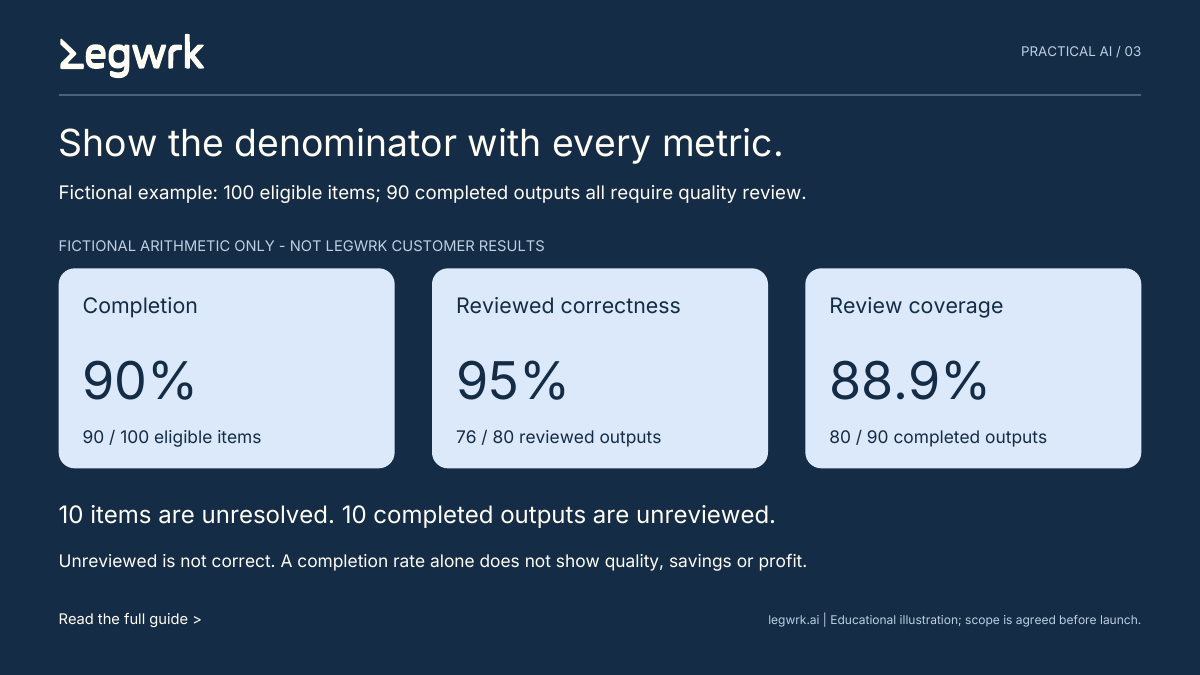
Define eligibility before the pilot and record exclusions with reasons. Completion rate uses all eligible items as its denominator, including work still open at the cutoff. Report that unresolved count beside the rate.
Quality needs two measures: reviewed-correct items divided by reviewed items, and reviewed items divided by all outputs requiring evaluation. Unreviewed work is not automatically correct. If a denominator is zero, report the result as unavailable.
Compare similar task types and disclose changes in workload, staffing or campaigns. A small pilot can guide the next decision; it does not by itself prove that automation caused a revenue change. Keep handling, review and exception minutes separate so the same work is not counted twice.
Make an explicit decision
Agree in advance what would justify expanding, revising, or stopping the pilot. A sensible decision considers accuracy, reliability, workload, customer experience, and cost together. A small improvement with predictable operation can be more useful than a fast workflow that needs constant rescue.
Document what changed, what was measured, what remains uncertain, and who owns the next review. Agree usage and scope before launch, and include monitoring and monthly review in the plan. Expand only when the evidence supports the next step. More customers. Less LEGWRK.